template.kicker
items.highAvailability.title
items.highAvailability.description
NebuaCloud helps you operate clusters in production, but it does not automatically provision infrastructure-level High Availability (HA).
HA architecture depends on your provider, virtualization platform, network model, and failure domains. NebuaCloud stays infrastructure-agnostic and focuses on validation, monitoring, lifecycle workflows, and operational guidance.
What is High Availability?
In Kubernetes, control-plane resilience is the core of HA:
- The Kubernetes API Server is the management entry point for your cluster.
- etcd stores cluster state and desired configuration.
- If you lose your only control plane node, running workloads can keep running.
- New deployments, scheduling, scaling, and many management operations stop until the control plane is restored.
That is why production clusters should avoid a single-control-plane topology.
Recommended Architecture
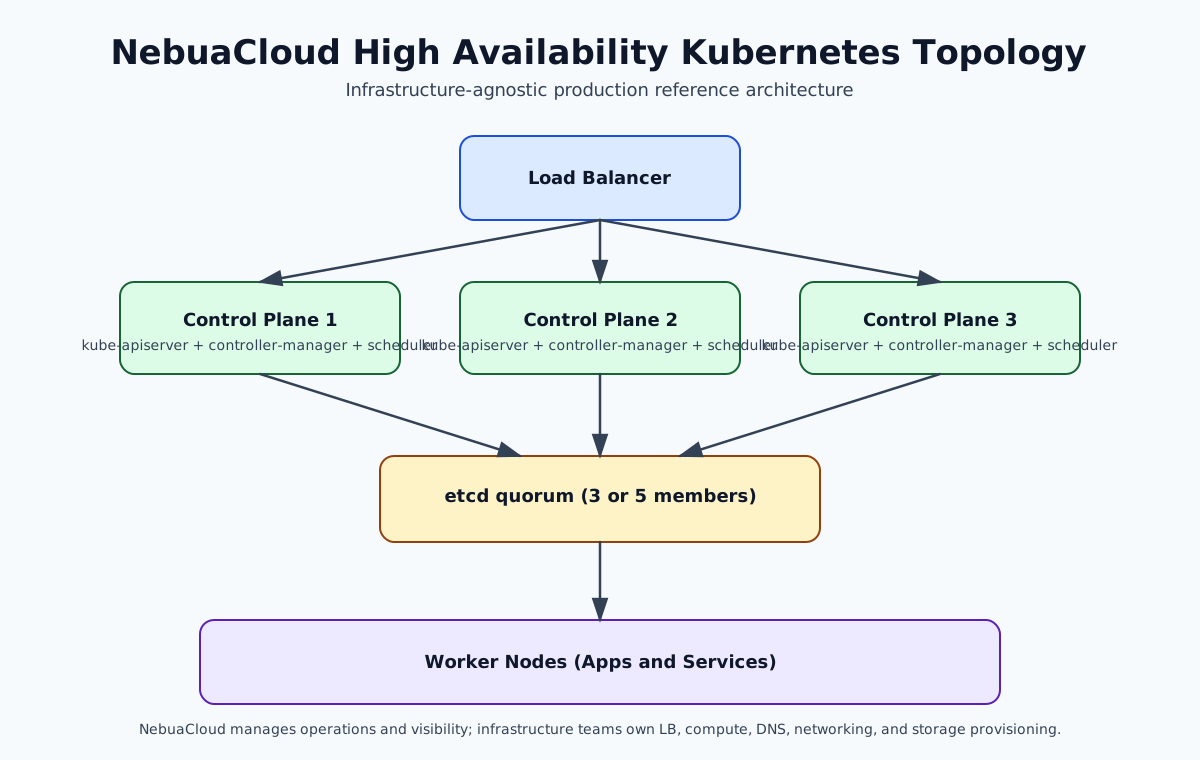
                 Load Balancer
                      |
      +---------------+---------------+
      |               |               |
 Control Plane   Control Plane   Control Plane
      |               |               |
      +---------------+---------------+
                      |
               etcd quorum
              (3 or 5 members)
                      |
                 Worker Nodes
Recommendations:
- Minimum 3 control planes
- Odd number of etcd members (3 or 5)
- Load balancer in front of API servers
- Separate failure domains for control planes
- Multiple availability zones where possible
Reference Architecture: Keepalived VIP for Private DC and Bare Metal
For private datacenters and bare-metal clusters, NebuaCloud can recommend the same proven production pattern already used in real deployments:
- Keepalived provides a floating Virtual IP (VIP) for the Kubernetes API endpoint (port 6443)
- Keepalived runs on every control-plane node participating in API failover
- One node is
MASTERand the remaining control-plane nodes areBACKUP - k3s control-plane nodes join through that VIP endpoint
- etcd quorum is maintained across control-plane servers
- Worker nodes also join through the same stable API VIP
Typical flow:
- Deploy Keepalived across load-balancer-capable nodes
- Expose a single API VIP (for example,
https://<vip>:6443) - Bootstrap first control plane with cluster init
- Join additional control planes against the VIP endpoint
- Join worker nodes against the same VIP endpoint
This pattern gives you a stable control-plane endpoint and avoids coupling cluster access to one machine.
Production Best Practices
Use this baseline for production readiness:
- 3 control planes
- 3+ worker nodes
- Load balancer for the Kubernetes API endpoint
- Automated backups
- Continuous monitoring and alerting
- Certificate lifecycle management
- GitOps deployment workflows
- Regular disaster recovery testing
NebuaCloud Support
NebuaCloud supports HA-ready environments by providing:
- Multi-control-plane management
- Worker scaling
- Node lifecycle management
- Node cordon workflows
- Node drain workflows
- Control Plane protection controls
- GitOps deployment management
- Cluster monitoring visibility
NebuaCloud does not automatically provision:
- Load balancers
- Servers or virtual machines
- DNS
- Networking
- Storage backends
- Infrastructure resources
Infrastructure examples for self-managed HA include Keepalived VIP, load-balancer daemons, host networking, and server lifecycle tooling.
These remain the responsibility of your infrastructure provider and cluster administrator.
Upgrade to HA Checklist
Use this checklist when your cluster is not yet highly available:
- Provision two additional servers
- Install Kubernetes prerequisites
- Join servers as Control Plane nodes
- Configure Load Balancer
- Update Kubernetes API endpoint
- Verify etcd quorum
- Test control plane failover
- Confirm cluster health
Future Roadmap
Future versions of NebuaCloud may provide guided High Availability provisioning, automated control-plane expansion, infrastructure integrations, and deeper resilience validation.
The current version focuses on validation, monitoring, lifecycle management, and documentation while remaining infrastructure-agnostic.